
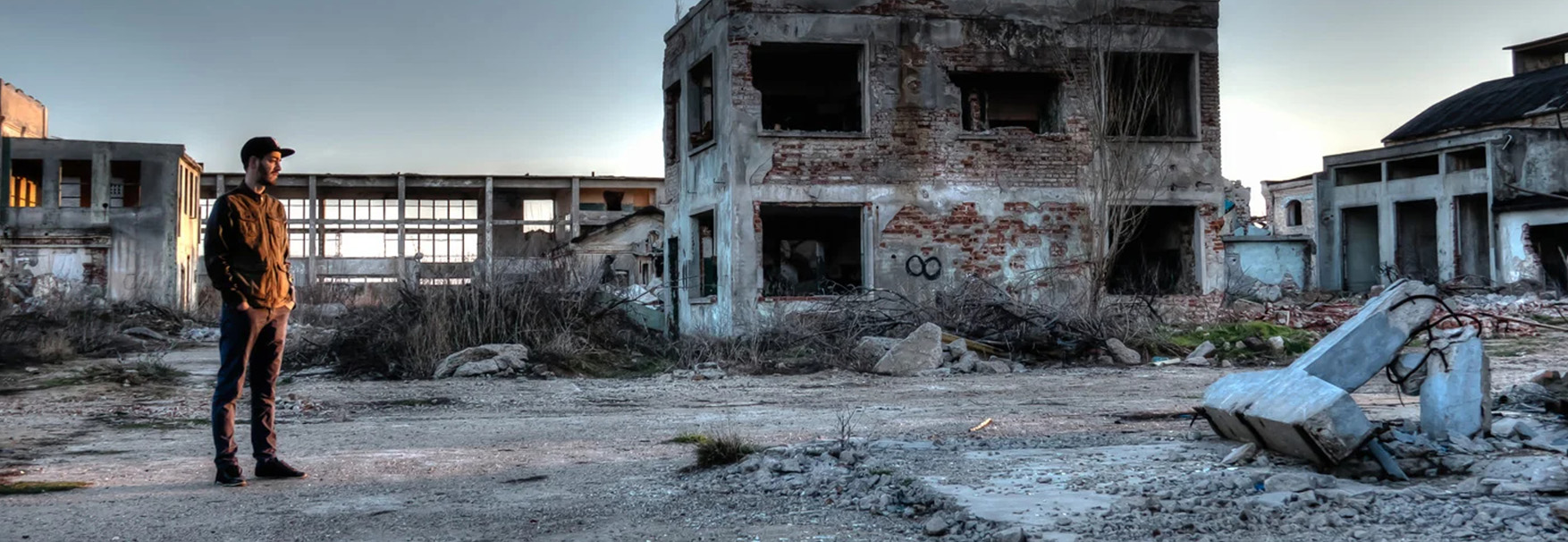
Can You Rebuild Civilization from Scratch?
What would it take to restore the knowledge, technology, and institutions that make modern civilization possible?
Imagine inheriting an entire civilization.
Cities, factories, power stations, aircraft, automobiles. All the machinery and infrastructure of a technologically advanced world.
There is just one problem.
You have no idea how most of it works.
And even if you learn, what happens when the machinery breaks down, the fuel runs out, or a vital component needs replacing?
This is one of the extraordinary challenges facing Jonnie Goodboy Tyler in L. Ron Hubbard’s science-fiction epic Battlefield Earth.
The year is 3000. Earth has been occupied for a thousand years by the Psychlos, an alien race that has exploited the planet’s resources and driven humanity to the brink of extinction.
The surviving humans live in scattered communities, largely unaware of the knowledge and technology their ancestors once possessed.
For Jonnie, a young man raised in the mountains of Colorado, discovering the world beyond his village is only the beginning. The greater challenge is understanding what it would take for humanity to reclaim its future.
The Problem with Inheriting Technology
At one point in Battlefield Earth, Jonnie surveys an enormous collection of Psychlo aircraft, vehicles, mining machinery, workshops, and supplies.
He recognizes their potential value to a recovering Earth. But he also understands their limitations.
As Hubbard writes:
“But plentiful as they were, they would run out and wear out eventually.”
Reclaiming this machinery is further complicated by the Psychlos’ extreme operational security. Their technology is deliberately designed to be tamper-proof, and their mathematical system has a hidden cipher buried in their formulas, making it impossible to decipher unless you are a Psychlo.
Consider a modern power station. Its turbines and generators may remain intact, but operating them requires specialized knowledge, fuel, replacement parts, and trained personnel. And who manufactures those replacement parts?
A power station depends upon an entire network of industries and skills. Without that network, even sophisticated machinery eventually becomes useless.
Possessing technology is not the same as possessing the ability to sustain it.
Jonnie’s dilemma illustrates a fundamental problem: rebuilding civilization requires much more than recovering its machines.
Food, Fire, and Knowledge
Where would you begin if you had to rebuild the world?
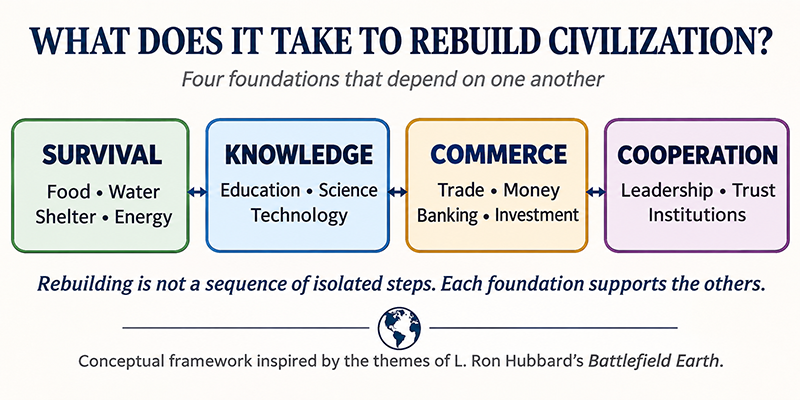
Food and water would come first. Without reliable agriculture and sanitation, survival itself remains uncertain.
Fire would provide warmth, cooking, and eventually the means to work metals and manufacture tools.
But neither food nor fire can restore a technological civilization without another essential resource: knowledge.

The Learning Machine from Battlefield Earth
Consider something as ordinary as a loaf of bread.
Producing it requires an understanding of agriculture, harvesting, milling, baking, and food preservation. Producing bread on a commercial scale adds machinery, transportation, energy, and distribution.
Now multiply those requirements across medicine, construction, communications, and manufacturing.
Each depends upon specialized knowledge that must be preserved, taught, and passed from one generation to the next.
In Battlefield Earth, Jonnie must learn to understand technologies far beyond anything he has encountered. But learning how to operate a machine is only the beginning. The larger question is how to make that knowledge useful to others.
Astrobiologist Lewis Dartnell has examined this challenge from a scientific perspective.
In a TED talk filmed in 2015, he considers how humanity might rebuild civilization following a global catastrophe, beginning with three fundamental areas: food, fire, and science.
Rebuilding More Than Machines
Suppose a community has restored electricity and learned to manufacture basic tools.
What comes next?
A hospital needs trained physicians, medicines, sanitation, and a reliable power supply.
A factory needs raw materials, equipment, transportation, and workers.
A city needs food, water, housing, and industries capable of supporting its population.
Each depends upon other systems that must also be restored.
Hubbard incorporates this complexity into Battlefield Earth. As Jonnie encounters different groups of survivors, bringing together people with different skills, backgrounds, and experiences becomes as important as mastering unfamiliar technology.
Rebuilding requires organization, cooperation, and leadership.
But there is another essential ingredient, one often overlooked in discussions of rebuilding civilization.
Money.
Who Pays for Civilization?
Imagine you have successfully restored agriculture, electricity, and manufacturing.
Now you want to build a hospital.
Who supplies the materials? Who pays the workers? How do you finance a project that may take years to complete?
Barter might serve a small community, but it becomes increasingly cumbersome as trade and specialization expand.
A farmer needs equipment before the harvest. A manufacturer needs capital to build a factory. A community needs resources to construct roads, schools, and water systems.
A functioning financial system allows people to exchange goods, invest in businesses, and finance projects whose benefits may take years to materialize.
Money does not create the resources. But banking, credit, and investment can help put them to productive use.
And here Battlefield Earth offers an interesting distinction.
Hubbard does not confine his vision of civilization to technological achievement. The novel also considers intergalactic commerce, banking, trade, and the institutions that allow societies to prosper.
These are not the subjects one ordinarily expects to encounter in a science-fiction adventure about an occupied Earth.
Yet they raise an intriguing question.
Even if humanity recovered the knowledge to rebuild its cities and industries, how would it organize the economic activity needed to sustain them?
That problem is every bit as important as learning to operate an alien machine.
The Human Element
There is still one requirement that cannot be supplied by machinery, scientific knowledge, or money.
People must be willing and able to work together.
Someone must organize the construction of a bridge, establish standards for clean water, settle disputes over resources, and coordinate activities that extend beyond a single community.
These are questions of leadership and government.
In Battlefield Earth, Jonnie’s journey brings him into contact with people whose circumstances and outlooks differ considerably from his own.
His challenges demand more than courage or technical ability. They require judgment, ingenuity, and the ability to enlist the help of others.
A machine can accomplish remarkable things.
But it cannot establish trust, inspire cooperation, or persuade people to work toward a common future.
Those remain human responsibilities.
Beyond Survival
There is a considerable difference between keeping people alive and creating a civilization in which they can flourish.
Survival requires food, water, shelter, and protection.
Civilization requires the knowledge, resources, institutions, and cooperation to build upon those foundations.
In Battlefield Earth, Hubbard imagines a humanity that has lost much of the knowledge and technological capability upon which its former civilization depended.
Jonnie Goodboy Tyler must confront dangers that threaten his very existence. But beyond those immediate challenges lies a larger question: What kind of future can humanity create?
It is one of the ideas that gives the novel a dimension beyond its action and adventure.
If civilization disappeared tomorrow, rebuilding it would demand far more than recovering its machinery or rediscovering its technology.
It would require people capable of learning, creating, organizing, and working together.
Because civilization is not simply what humanity builds.
It is what humanity knows how to build again.
Sources and Further Reading
Lewis Dartnell, The Knowledge: How to Rebuild Our World from Scratch (2014).

Leave a Reply
Want to join the discussion?Feel free to contribute!