
Before Rewilding Had a Name, Battlefield Earth Imagined It
Guest blogger Dr. Lee Carroll (AKA EL Whitehorse)
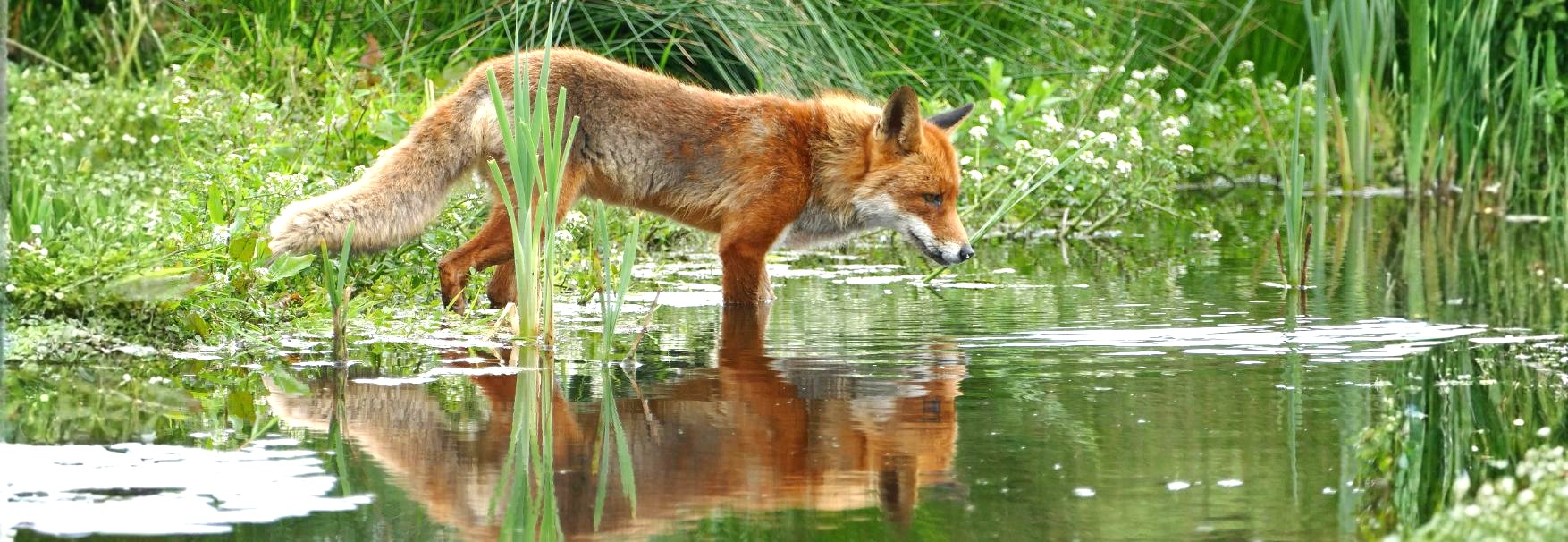
Picture the Rocky Mountains in the year 3000. No cities worth the name. No highways, no farms, no fences. Just grass running to the horizon in every direction, herds of wild cattle thick across the plains, a few wolves working the edges, and somewhere up in the high meadows a bear that has never once seen a human being.
That is the world Jonnie Goodboy Tyler rides out into on the first page of Battlefield Earth. Most readers file the scene under “after the apocalypse” and hurry on to the aliens. Fair enough. There are aliens coming, and they make for wonderful villains. But go back and look at that opening landscape again, because Hubbard slipped something past us in 1982 that took the rest of the world another decade to even name.
He drew a planet that healed.
What Jonnie Actually Sees
The Psychlos hit Earth with a single gas strike roughly a thousand years before the novel opens. Humanity got knocked down to a few thousand survivors, scattered and hiding in mountains and hard country, out of reach and out of contact with one another. That is the tragedy, and Hubbard does not soften it. He opens the entire novel on it, in Terl’s voice:
“Man,” said Terl, “is an endangered species.”
Here is the part nobody talks about. While the human story went dark, the wild story went the other way.
When Jonnie comes down out of the mountains, he crosses an ocean of grass two days wide. Wild cattle by the herd. Wolves that barely register to him as a threat. Hubbard writes it from inside the boy’s easy confidence: “A few wolves, but what were wolves? No bear, no puma so far.” He clocks the missing predators the way a hunter notes the weather, meaning both are common enough that their absence is worth remarking on. His horse Windsplitter carries him across country that a thousand years earlier had been highway and suburb and shopping strip.
That is not a dead planet. That is a thriving one. The catastrophe fell on people. The land, freed of us, got busy.
The Word That Had Not Been Invented Yet
We have a term for this now. Rewilding. It means pulling human pressure off a landscape and letting the wild take the wheel again. The word did not enter common use until the 1990s, and it did not really go mainstream until this century.
Hubbard wrote the whole idea into his opening chapters in 1982, before the vocabulary existed to describe it. He did not call it rewilding. He just drew it, and drew it accurately, right down to which animals bounce back first and how fast grass swallows a road.
Lucky guess? Maybe. But here is what makes it fun. We now have real places on Earth where the people vanished and the cameras kept rolling, and the footage looks startlingly like Jonnie’s plain.
Exhibit A: The Wolves of Chernobyl
In April 1986, a reactor at Chernobyl blew and threw out hundreds of times more radioactive fallout than the bomb dropped on Hiroshima. Everyone left. More than 200,000 people evacuated a zone of about a thousand square miles, and they never came back.
Then something nobody scripted happened. The animals moved in.
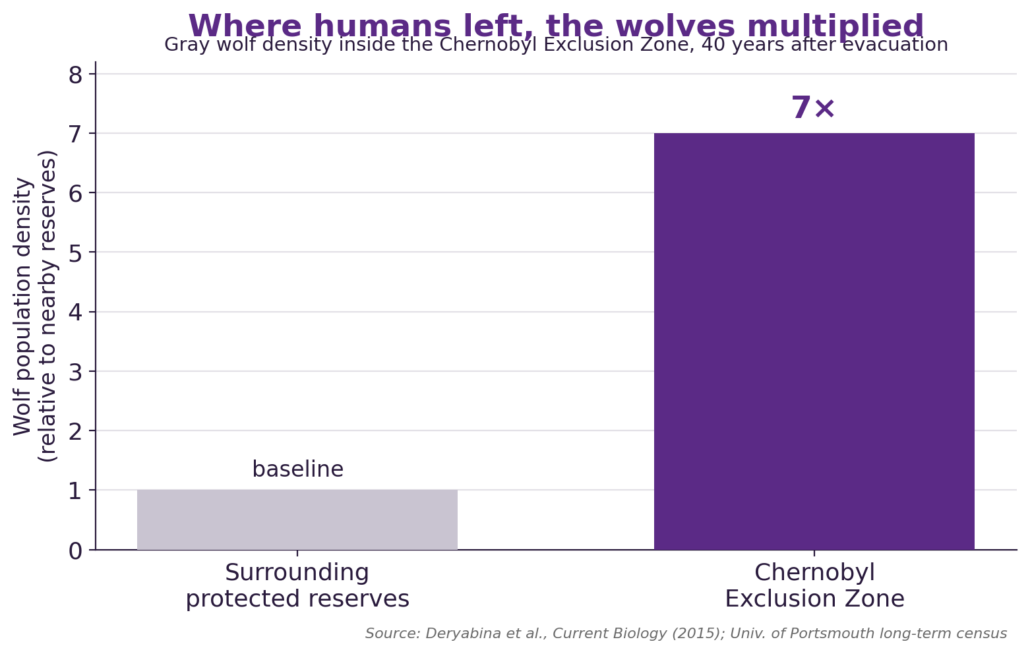
Forty years on, and the disaster passed its 40th anniversary this past April, the exclusion zone reads less like a wasteland and more like a nature preserve with a very strange backstory. A long-term census published in Current Biology (by T.G. Deryabina et al., 2015) found moose, roe deer, red deer, and wild boar living there in numbers that match clean, uncontaminated reserves nearby. The wolves did better than match. Their density inside the zone runs about seven times higher than in the surrounding protected areas.
Seven times. In the place we all assumed was too poisoned for anything to live.
The scientists are careful about what this means, and so should we be. Radiation is not good for wildlife. The point the researchers keep returning to is sharper and stranger than that. Whatever harm the radiation does, the absence of us does more good. Hunting, farming, roads, habitat loss: those turn out to be a heavier boot on the natural world than a nuclear meltdown. Pull the people out and even a contaminated forest fills up with life.
And there is a recent twist Hubbard would have loved. Those Chernobyl wolves show genetic changes linked to cancer resistance, adaptations that researchers at Princeton (Love & Campbell-Staton) are now studying for what they might teach human medicine. Life did not merely survive the zone. It started solving the zone.
Exhibit B: The Accidental Eden Between Two Armies
Now cross the planet to Korea.
When the fighting stopped in 1953, it stopped without a peace treaty. The two sides pulled back and left a strip of land about 160 miles long and a couple of miles wide sealed between them, mined, fenced, and watched around the clock. Nobody has farmed it, built on it, or hunted it in more than seventy years.
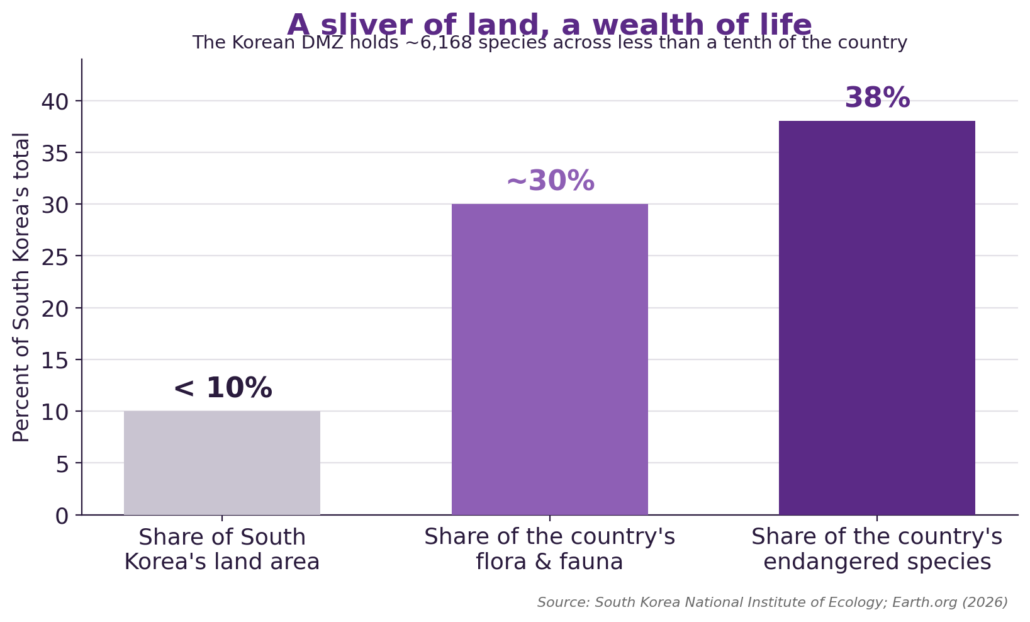
That strip is now one of the most biodiverse places in the whole country. South Korea’s National Institute of Ecology counts roughly 6,168 species living there: plants, mammals, birds, fish, amphibians, reptiles, insects, and more. Among them sit 38 percent of the nation’s endangered species, packed into a ribbon of land that makes up less than a tenth of South Korea. Seven of the world’s fifteen crane species winter in it. Musk deer, Asiatic black bears, leopard cats, and long-tailed goats pick their way through the minefields as if the fences had been built for their benefit.
Kim Seung-ho, who directs the DMZ Ecology Research Institute in the Korean Demilitarized Zone (DMZ)—the strip of land separating North and South Korea—put the irony better than I could. He has said he used to think he was the finest conservationist around, until he realized the landmines were doing more for the wildlife than any person ever had (Taipei Times, 2025).
Same lesson as Chernobyl. Same lesson as Jonnie’s plain. Take the pressure off, and watch what comes back.
Terl Was Standing in a Miracle
Here is where the novel turns quietly brilliant.
The Psychlos came to Earth for exactly one reason: to strip it. Gold, minerals, whatever the planet would surrender before they packed up and moved on. Terl, the security chief who drives so much of the story, looks at Earth and sees a mining claim with an annoying infestation of “man-animals” cluttering up the dig site.
He is standing in the middle of one of the great wildlife recoveries in the planet’s history, and he cannot see it. To a Psychlo, a forest is overburden. A herd is a nuisance. An ocean of grass is just the stuff you scrape off to reach the ore underneath. The single most valuable thing on the whole planet, a living world in full and glorious rebound, is invisible to him because it does not fit anywhere on his balance sheet.
That blindness is his real flaw, deeper than his cruelty. He mistakes a garden for a quarry. And it happens to be the exact blindness that rewilding science keeps trying to cure in the rest of us: the old habit of pricing a landscape only by what we can haul out of it.
What Jonnie Inherits
So think again about that first page.
Jonnie Goodboy Tyler is not the last man scratching a living off the corpse of a planet. He is the heir to a world that spent a thousand years getting healthy while nobody was watching. The cattle, the grass, the wolves, the clean rivers, the mountains full of game: that is his inheritance, and it is a rich one.
The tragedy of Battlefield Earth is what happened to people. The promise underneath it, the reason the book can end in hope rather than ash, is that the Earth itself was never actually beaten. It was only waiting.
Chernobyl proves it across a thousand square miles. The Korean DMZ proves it in a ribbon between two armies. Hubbard drew it across a whole planet, then handed it to a twenty-year-old on a fast horse and told him to go find out what he had.
Turns out he had everything.
Read the book that saw it coming. Get Battlefield Earth here.
 Dr. Lee Carroll (AKA EL Whitehorse)
Working abroad in 10 countries of Europe, Asia, Africa, North and South America, both as a doctor and teacher, has shown me life through a prism of viewpoints. That experience has enriched my writing to the point where I enjoy showcasing the admiration I feel for varied cultures.
For example, my WOTF Semi-finalist entry is published for Kindle as Death Clearinghouse: The Novelette, featuring Apache ingenuity.
When I’m not writing, I’m yanking swords out of stones around the world.
(Amazon author page: https://www.amazon.com/stores/author/B07TRC1F4V/about)
Bibliography
Deryabina, T. G., Kuchmel, S. V., Nagorskaya, L. L., Hinton, T. G., Beasley, J. C., Lerebours, A., & Smith, J. T. (2015). Long-term census data reveal abundant wildlife populations at Chernobyl. Current Biology, 25(19), R824–R826.
Hubbard, L. R. (1982). Battlefield Earth: A saga of the year 3000. Galaxy Press.
Love, C. N., & Campbell-Staton, S. C. (2024). Chronic radiation exposure and evolved cancer resilience in Chernobyl gray wolves [Conference presentation]. Society for Integrative and Comparative Biology Annual Meeting.
National Institute of Ecology (Republic of Korea). (2024). Wildlife of the Korean Demilitarized Zone. Google Arts & Culture. https://artsandculture.google.com/
Nuktarov, S. (2026, February 6). A symbol of hope: How the Korean demilitarized zone turned into a wildlife sanctuary. Earth.org. https://earth.org/
Smith, J. T. (2026, April). Long-term wildlife recovery in the Chernobyl Exclusion Zone [Interview]. The Guardian.
Taipei Times. (2025, August 23). How wildlife is thriving in the Korean DMZ. https://www.taipeitimes.com/


Leave a Reply
Want to join the discussion?Feel free to contribute!