

There’s Gold in Battlefield Earth
Guest blogger John Carey
Everyone’s heard the famous line, “Thar’s gold in them thar hills.” It comes from Mark Twain’s character Colonel Mulberry Sellers in The American Claimant, though most of us know it best from the Looney Tunes character Yosemite Sam. The lure of buried treasure has stirred humanity’s imagination, dreams, and greed for centuries. That same quest lies at the heart of L. Ron Hubbard’s epic science fiction novel Battlefield Earth—and helps explain why man has become an endangered species.
History of Gold
Gold has carried immense value across the millennia. While used for jewelry, art, medals, and electronics, its greatest role has always been as wealth. Fads like tulip bulbs, Beanie Babies, Elvis memorabilia, and baseball cards may soar in price one day and crash the next—but gold endures. And can be traded for whatever you need.
A few milestones in gold’s history:
- 3100 BC: Records from Egypt’s first dynasty stated that “one part of gold is equal to two and one-half parts of silver.”
- Circa 1324 BC: King Tutankhamun’s funerary mask, made of 22 pounds of gold, was buried with him and is now displayed at the Egyptian Museum in Cairo.
- Circa 1320 BC: A papyrus in the Turin Museum shows the world’s first gold treasure map from ancient Egypt.
- Circa 600 BC: Lydian (an ancient kingdom in modern-day Turkey) merchants minted the first coins (a mixture of gold and silver) which greatly assisted their traders and wealth.
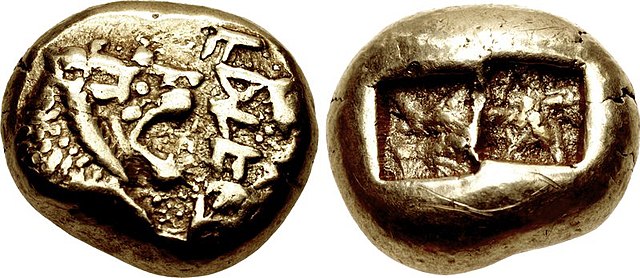
One of the earliest coins from the Lydian Kingdom. Credit: Classical Numismatic Group, Inc. http://www.cngcoins.com
- 1300s: To certify their standard of purity, Goldsmith’s Hall in London introduced hallmarking gold, stamping a mark on precious metal objects.
- 1717: Great Britain adopted the gold standard, tying its currency to gold.
- 1848: The California Gold Rush brought hundreds of thousands to the West, leading to statehood in 1850. California’s motto, Eureka! (Greek for “I found it!”), and nickname, The Golden State, both come from this event.
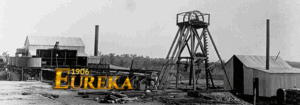
(1906) Eureka, California, a city also named for the Greek “I found it!”
1971: The United States abandoned the gold standard for their money supply.
- 20th–21st century: Last but not least, here is a telling chart of where we stand on gold prices since the 1970s:

Gold has increased from less than $100 per ounce in the 1970s to over $3,000 per ounce in 2025.
Why Is Gold Valuable?
Gold is universally recognized and found around the world, making it valuable in trade across cultures and continents. Early traders or travelers understood the value of gold wherever they found it or arrived to trade it.
Gold has a distinctive weight that helps to identify this heavy metal. It is beautiful, scarce, and often occurs in pure form—unlike iron, which must be smelted from ore. Gold’s luster, malleability, and resistance to tarnish make it ideal for jewelry, art, and electronics.
Because of these qualities, it has held value for thousands of years. Other assets are less reliable: Vincent van Gogh’s Portrait of Dr. Gachet sold for $82.5 million in 1990, then resold seven years later for $50 million. Still a fortune, but a $32 million loss nonetheless. By contrast, gold has historically recovered or appreciated in nearly every seven-year span, aside from periods of extreme inflation.
Gold in Literature and Movies
- Jason and the Argonauts sought the Golden Fleece, a myth rooted in the real practice of trapping gold flakes in sheep hides.
- Pirate tales almost always revolve around buried gold and treasures. The classic is Robert Louis Stevenson’s Treasure Island. Michael Crichton’s Pirate Latitudes is another fine example.
- The Treasure of the Sierra Madre (1948), starring Humphrey Bogart, shows how lustful greed for gold can drive men to madness.
- In Pirates of the Caribbean: The Curse of the Black Pearl, cursed golden medallions power the story.
Gold in Battlefield Earth
In the story, the alien Psychlos discover NASA’s Voyager spacecraft carrying a gold-plated record and maps pointing to Earth.
With this knowledge, they invade, decimate humanity, and enslave the survivors. The aliens immediately seize gold from banks and Fort Knox, but the scheming Security Chief, Terl, wants more. Spotting a vein of gold in reconnaissance photos, he secretly trains human Jonnie Goodboy Tyler to lead a mining crew.
Jonnie, however, has his own plan: rebellion. When the mine disappoints, he and his crew must devise another way to secure gold and keep their uprising hidden. The result? Let’s just say the Psychlos weren’t the only ones capable of deception.
Author’s Working Notes
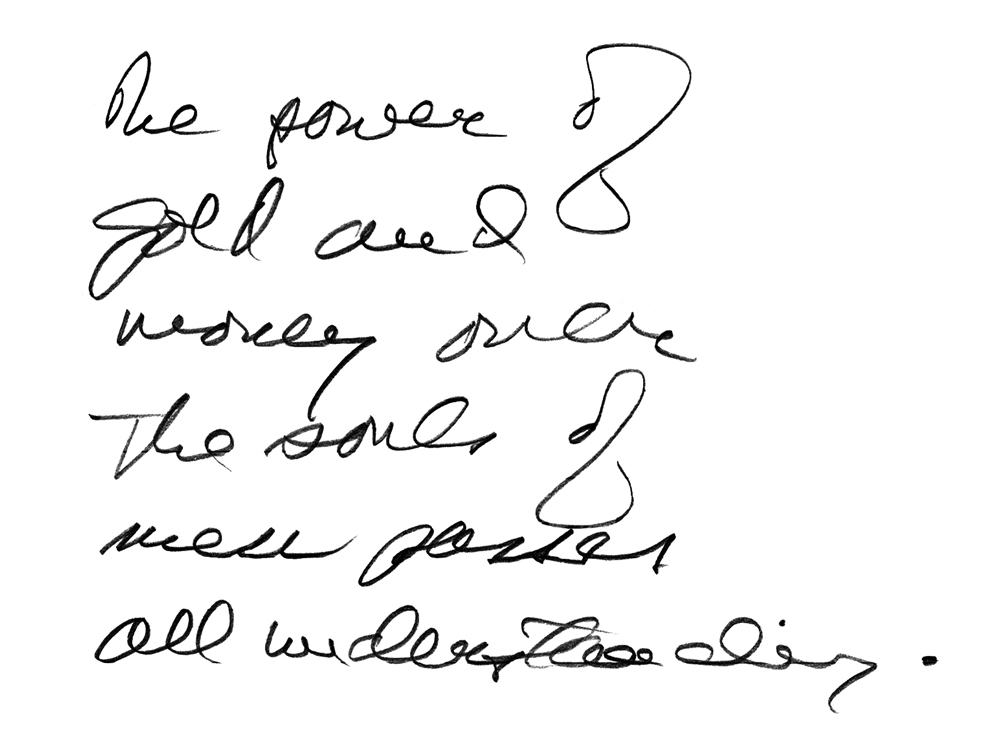
L. Ron Hubbard produced more than seven hundred pages of handwritten notes while writing Battlefield Earth. In them, he sketched scenes, described character traits and outlined technical details that he could refer to as the story moved forward. The power of gold and money over man (and aliens!) is a central part of the plot in Battlefield Earth.
Closing
Some science fiction imagines civilizations beyond base desires. But the most compelling stories confront ambition, greed, and folly, the very traits that we recognize in all races of our fellow human species.
Despite centuries of advancement, humanity has not transcended the pull of wealth. The behavior of today’s billionaires suggests Battlefield Earth got it right: “The power of gold and money over the souls of men passes all understanding.”
So instead of worrying about stockpiling scarce gold, enjoy one of the greatest science fiction adventures ever written—and discover the “gold” of this story.
 John Carey has degrees in Chemical Engineering and Computer Science from Texas A&M University which paid the bills while he crafted his writing skills at nights and weekends. Of all of his writing, John’s non-fiction articles on the overmedication of children have been the most circulated. John has just published his second book, Not Worthy of the Air you Breathe set in the future where nations have taken a cue from the business world and terminate their low performing citizens at the end of each year.


Taking this spot to say what adventure and enjoyment come from John Goodman’s newsletters. Magnificent in so many ways! 🤎 🛸 🤎